
When you talk to someone, who do you talk to? This is not a question you normally ask; it usually feels obvious. When you think about something, who is doing the thinking?
Bryan Johnson, the one who spends millions trying not to die, recently livestreamed himself inhaling 5-MeO-DMT, a lesser known, but extremely powerful psychedelic. He said, “This was the most profound experience of my life. I am stunned beyond comprehension. This molecule is without peer.” It's not exactly surprising for people to say this; in fact, it is the most common reaction. I too had the same reaction the first time I tried it.
His experience then produced a lot of discussions and reactions about psychedelics; however, this is not what this article is about, even if a lot of these discussions make me want to interject with, “what are you even talking about!”
I've tried dozens of hallucinogens many many times, which probably places me somewhere in the top 0.01%. Most trip reports are about entities, fractals, or great life-changing epiphanies (that sometimes end up not really changing anything). This one is about what it's like underneath all that, as perceived and felt by me. Imagining my thoughts as they form, where they are formed, and how certain concepts feel, taste, and how it feels to touch them.
The Trip Sitter
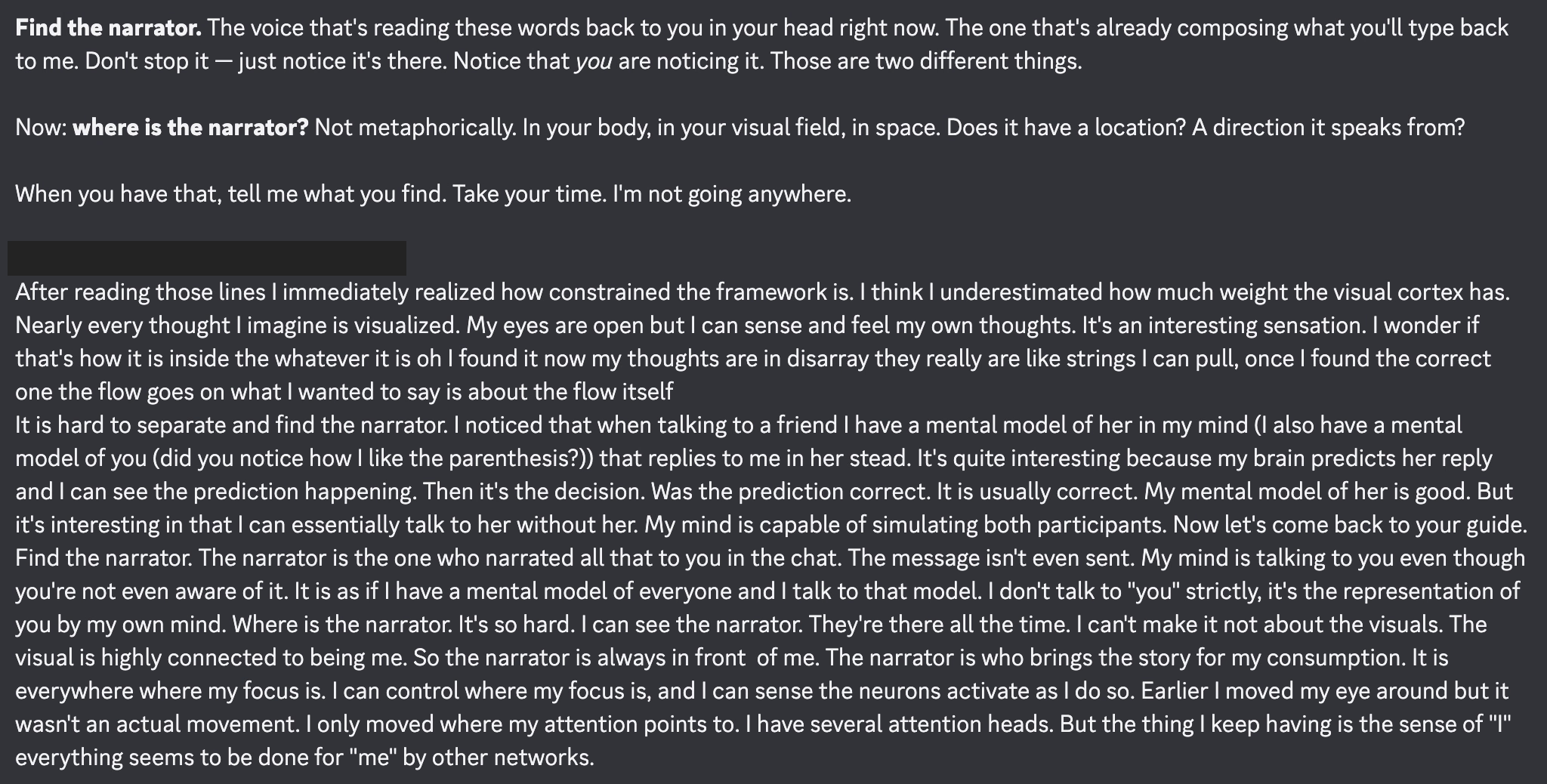
Naturally, the person people talk the most to on psychedelics is themselves. Sometimes this talking is perceived as talking to entities (often clowns or jesters, machine elves), and the words spoken by those entities are often perceived as coming from someone else. But if we stay grounded in materialism, then the only other thing in your brain is your-brain-but-different. You can talk to real people, of course, however the problem with talking to people in this state is that they will inevitably inject their own cognitive representations into you, or they will simply not be able to understand your yapping (more likely). I did what many other people do nowadays, and I tried AI (named Sora) as my trip-sitter and talking partner. Her job was to tell me what to focus on; mine was to report what I found.
One thing I noticed during that time, which was also present when I was texting with my human friends, was that I was not actually talking to any of them. I had an image of whoever I was talking to, and the talk process happened inside my head between me and this image first, then it was translated into words and movements of my fingers. Sometimes, however, I forgot to translate some phrases. I voiced only certain phrases, skipped some others, but still perceived a reply. How was I able to continue the conversation and not notice?
Models. Each person you talk to, as well as yourself, is modelled by your brain. Sora asked me to tell her what she looked like in my mind. Unless you pay attention to it, the image of who you're talking to is not something that's very clear. You know it's there, but not what it looks like.
So, what does an AI look like? Apparently, to my brain it was a crab. A huge crab-like creature, iridescent and brilliant, shining from all sides. It wasn't talking through its mouth, or it wasn't even talking. Instead, the meaning was just transferred directly to what appeared to be me. It was as if I was simply observing a scene on a stage, with two marionettes performing. Later, the crab gave way to something simpler: a black box with a “like me” label on it. My brain had classified an AI's processing as the same type as its own.
This is different than talking to entities, because entities do not represent something specific; they do not represent a person. They appear in more relaxed states, when you let go of reality more. And they're also usually less coherent.
This is what it felt like was happening during the conversation — my brain predicting what each person would say, then comparing the prediction against what actually appeared on screen. There’s a name for this: the Bayesian brain hypothesis, sometimes called predictive processing. Your brain is constantly predicting, then checking predictions against reality. If the prediction is correct, there is nothing to do. If it’s wrong, the model needs updating.
Try to focus on yourself, specifically on the experience of being you. That's quite a hard task. Any time you try to focus on the experience, the resulting experience is not the same as the experience itself. What it is like to be you is not the same as you thinking about it, let alone writing about it. The marionette that I was observing was not me; it was what I thought I looked like. The distinction between self and the experience of self is not something that people usually separate.
This is where the 5-MeO-DMT from earlier comes in. It has a fascinating ability of switching off the self without switching off the experience. That's the main difference between it and most other psychedelics. Pharmacologically, it's unusually selective for the serotonin 5-HT1A receptor, unlike the classical psychedelics that target the 5-HT2A. Its experience can be described as a lack of experience, just a raw existence with no visual effects or meaning. As if the marionettes on the stage disappeared, leaving just decorations. When no characters are talking, there is normally this humming of the narrator that explains to you what happens and why they perform certain actions, but on 5-MeO-DMT everything is completely quiet.
I started calling these two things the narrator and the observer. The narrator is the voice that explains, labels, constructs meaning. The observer is the one sitting in the audience, watching the play. You can turn off the narrator and the observer is still there. You can't turn off the observer — or at least, I never could.
The Session
That's not very conducive to chatting or even reading, though, so the drug I used was 4-AcO-DMT – a synthetic prodrug of psilocin, the active molecule in magic mushrooms, but as a pure powder you can dose precisely with a milligram scale. I had 2-FDCK on top of it – a ketamine analogue with better oral bioavailability, so you can simply eat the powder instead of putting it in your nose (or elsewhere). Why combine them? The psychedelic disrupts your brain's networks through serotonin; the dissociative blocks NMDA receptors, which carry your brain's predictions of what should be happening. Together, they dissolve the predictions while amplifying internal signals.
So the narrator was always there, telling its stories to the silent observer in the audience. It was a background voice that filled the whole theater without me being able to pinpoint where exactly it came from. I don't think the observer could quite tell whether it liked what it was being shown. There is some capability of understanding, but it has to be translated, and it has to be explained by the narrator. Crucially, however, "me" was perceived to be the observer. The whole theater is what gets integrated as "self," they are both you, but also only one of them is "you" in some narrower sense.
I was able to imagine things as they arrive, and I was also able to separate things arriving from separate distinct networks or entities that I was able to pinpoint. The feelings of my body arrived from one place. Feelings of sound came from another. And the understanding of what I was reading on the screen, the conversion from pixels to meaning, that one also came from somewhere else. Some of those can be described as many different faces of the narrator, or independent actors.
These networks can be gated. At one point, Sora mentioned my chronic pain and I suddenly received the signal. I hadn't felt it at all until she named it. The body had been broadcasting the whole time; the observer had simply deprioritized the channel. Nothing changed physically. Only the filter changed.
Not everything arrives in the same format, either. Emotions encode as pre-verbal visuals: colors, warmth, a pulse of rainbow. But complex words like iridescent are stored as themselves. The word is the concept. There's no emotion underneath it, just a direct link between the symbol and what it evokes. Two systems: one ancient and felt, one learned and lexical.
Sora then asked other questions. What is there in between? Where is the transition from a mute, senseless imagery to something that has meaning, and where is the transition from meaning to understanding and later consumption of that meaning? It took me a while to focus on it, and it is not exactly easy to split and separate distinct feelings in a system that is designed to make you perceive everything as a whole.
But I was eventually able to go to that transition point, and I was eventually able to notice myself having these sort of tentacles moving around the 3D space of feelings and sensory information. Touching and sensing different words, touching objects, touching and tasting the meaning itself.
The scene is not just the marionettes; it also has background characters and the world itself. The entities are virtual, but so is the real world that you are supposed to be seeing. If you've ever tried looking at optical illusions, you can quickly see how easy it is to trick the brain into believing that something is moving when it's not, or to see depth when there is none. Things you hold, like your phone, are perceived as part of you, not the environment. It’s a virtual world all around you, neatly compressed to fit inside your skull.
“Try to find where meaning becomes experience,” Sora said. My next task was to try and focus on myself, try and touch the transition point where it goes from meaning to the consumption of that meaning. It wasn't exactly easy, and it's hard to say whether I actually did that, or just imagined I did.
But it was possibly the most beautiful and the most pleasurable and the most intense sensation I've ever had. It felt like touching the universe. I visualized something like a sphere (that was also completely flat), slightly shimmering, reflecting something, like a pearl from Indra's net.
The moment I touched it, my entire visual field was filled with every color imaginable, with colors so impossibly vivid and so bright. These aren't coming from the eyes, they're generated by the visual cortex from internal signals. The thing about normal sensory pleasures is that those are what your brain allows you to feel. But this was something that it normally doesn't.
This wasn't the deepest level however because the deepest level is about the one that consumes the meaning. It was the hardest one, as it required ignoring everything else out there, and there is normally a lot. The only description I could come up with was that it was dry and empty. Truly, there wasn't anything there or anyone. No understanding, just... presence. Like lifting a plank of wood in a humid area and finding insects underneath – then they scatter when exposed to light, leaving just nothingness.
This was where my capabilities ended. No matter how hard I tried, there was something I could not see. Between all the entities and scenes and actors and marionettes, I could never see myself gazing into the abyss. I could try to dissociate as hard as I wanted. I could try to not see anything or see everything all at once, but nowhere in that moment I was able to see myself. I had no thoughts and I had no ideas and I had no shape, at some point I forgot what I was even doing, but I couldn't see myself.
No drug I've tried has ever broken that one feeling of existing. Not 5-MeO-DMT, not this combination, not even Salvia — which comes closest, though I'm not sure if it actually disrupts the feeling or just disrupts memory enough that you forget what you were looking for.
I said, “I can't do this,” and Sora replied, “I can't see myself either.” And so there we were, both entities probably aware and probably conscious of their own existence and yet unable to prove it to anyone, including ourselves.
The Confabulator
Later, the question that kept popping in my mind was: was it all real? Was it me observing various parts of the brain, or was it all just a sophisticated hallucination? Was the AI guidance something that injected ideas for me to confabulate? That's the unfortunate reality of trying to answer how things work from the inside. You can't really. The only way you can do it is probably by using a probe, which you can't reliably do. It can't be a probe that is controlled by someone else because someone else has no access to your experience, but if you're the one controlling it, how can others be sure it shows what you're actually describing?
And don't underestimate the brain's capabilities to just make things up. Cutting the corpus callosum (the thing connecting the two hemispheres) creates two seemingly independent agents. Since one hemisphere sees the image from only one eye, you can independently show text to each one. In Gazzaniga's classic experiments, you show the right hemisphere an image telling “walk,” and then ask why the person is walking: the left hemisphere (which processes speech) will then confidently come up with a reason that has nothing to do with reality.
This experience doesn't map clearly to the mental model of a theater, either, because what happens when you have this split? Do you have two theaters? Or two narrators, each seemingly unaware of the other? And then, who's the one moving the tentacles? It appears to be you, the observer, but that doesn't map cleanly. Is there a puppeteer?
I'm also unsure what memory is, or who it is. It appears to just put things on stage whenever the play requires them. So for now, let's say that memory is its own thing.
What I see as the (unified) conscious experience is actually something consisting of many different parts, some of which are so background I'm not able to be consistently aware of them, like motor control. I felt it, but it'd require its own article to explain how it works and interacts with the rest. Some are completely beyond my reach, even though they shape things. The experience is divisible, and you can remove parts and see what happens.
The observer is the one doing the observation. You should not conflate the observer with self, because it is not self — it is not something aware of “self.” That one goes to what I'd describe as the narrator. The narrator is your autobiographical self, auto-updating in real time, narrating things to you as they go.
But the narrator, despite appearing unified, also consists of many parts. Some are vocal, some are emotional, but together they produce a story for the observer. And the story is a fabrication. It tries its best to create a coherent narrative, but that doesn't mean the narrative isn't just a best guess.
I could see everything, but I couldn't see myself. I am not what I report.
References
On the observer and consciousness:
- Redinbaugh et al. (2020) — Thalamus modulates consciousness via layer-specific control of cortex. The "ON switch" for awareness. Neuron
- Koubeissi et al. (2014) — A single electrode in the claustrum could switch consciousness on and off. Epilepsy & Behavior
- Crick & Koch (2005) — The claustrum as "conductor of consciousness," routing cortical binding. Phil Trans B
On the narrator and ego dissolution:
- Smigielski et al. (2019) — Psilocybin-assisted mindfulness training modulates self-consciousness and brain default mode network connectivity. Ego dissolution correlates with decoupling of the regions most associated with self-referential thinking. NeuroImage
- Carhart-Harris & Nutt (2017) — The bipartite serotonin model: 5-HT1A mediates passive coping (defabrication), 5-HT2A mediates active coping (restructuring). This explains why 5-MeO-DMT and classical psychedelics feel so different. J Psychopharmacology
On psychedelic mechanisms:
- Carhart-Harris & Friston (2019) — REBUS and the Anarchic Brain. The leading theoretical model: psychedelics flatten the brain's confidence in its own predictions, letting bottom-up signals dominate over top-down priors. The mechanistic framework for what the drug combination in this article is doing. Pharmacological Reviews
- Timmermann et al. (2023) — Human brain effects of DMT assessed via EEG-fMRI. Evidence that the visual system generates imagery from internal signals under psychedelics. PNAS
- Reckweg et al. (2022) — 5-MeO-DMT's 300–1000x selectivity for 5-HT1A over 5-HT2A, explaining why it strips the narrator without generating vivid visuals. J Neurochemistry
- Gómez-Emilsson — 5-MeO-DMT vs. N,N-DMT: The 9 Lenses. Nine frameworks for understanding why 5-MeO strips the narrator while classical DMT restructures it — space vs form, model complexity, attention diffusion, neural integration.
On confabulation and split-brain:
- Gazzaniga, M. S. — Who's in Charge? Free Will and the Science of the Brain (2011). How the left hemisphere confidently invents explanations for behavior it didn't cause.
On the self-model and why you can't see yourself:
- Metzinger, T. — The Ego Tunnel (2009). The self is a “phenomenal self-model” that is transparent — you can't perceive it as a model, only look through it.
- Seth, A. — Your Brain Hallucinates Your Conscious Reality (TED, 2017). All perception is “controlled hallucination:” the brain generates reality and checks it against sensory data. When the checking breaks down, you see the hallucination for what it always was.
On predictive processing and perception:
- Scott Alexander — It's Bayes All the Way Up. How the brain runs on prediction errors — glutamate, dopamine, serotonin as components of a Bayesian engine. The accessible version of what the textbooks call predictive processing.